In much popular comment Charles Darwin’s “Origin of Species” is viewed as almost immediately causing one of the greatest storms in intellectual history by directly threatening the old Biblical view of creation and challenging the whole existence of God. This was not quite how it actually happened at the time, as scholars have long pointed out, although Darwin’s long time impact proved to be great. He did indeed challenge the central issue of man’s place in nature, the whole question of Nature, Humanity and God. There was indeed some fierce squabbling, and there were emotional reactions at the time, but in hindsight what is surprising is how relatively calm was the immediate debate (especially in Britain).
There was no “war” between science and religion at this time. Not all clerics were anti-science, nor were all scientists anti-religious – far from it. There were outspoken sceptics such as T. H. Huxley, John Tyndall and Francis Galton. On the other side you could set devout Christian scientists such as Charles Lyell, Faraday, Lister, Asa Gray and Clerk Maxwell. There were a number of possible responses to the cultural shock of Darwinian evolution. One was a sort of existential acceptance of a Godless universe. Another was to find a reconciliation between religion and science. More on this soon.
Yearly Archives: 2015
An Illustrated ORIGIN OF SPECIES (my 2009 review)
David Quammen’s sumptuous illustrated edition of Darwin’s Origin of Species appeared in time to celebrate the 150 years since the publication of this world-shattering book. The wide range of portraits, paintings, photos, engravings, press coverage, botanical and zoological specimens also give insight into Darwin’s life and times, and quiet but relentlessly inquiring mind.
My 2009 review of this book is attached (click link).
Getting older – all in the mind?
Many people as they age simply imagine that they can’t, or shouldn’t, do certain things because they are too old. They are meeting expectations.
What they should do, in Buddhist philosophy, is to have as one of their goals this:
to remain at the “most youthful level of functioning possible”.
Our Japan trip 2013: Takayama to Nagano
We could have travelled by fast train to Nagoya, but chose the more picturesque route using local trains. This took us through the Hida, the Japanese Alps, rather than through the flat lands with wall to wall residential. We went Minoota-Tajimi, then Shinanano Express with large viewing windows to Nagano. This express was disappointingly one minute late, arriving at 16.55 pm (someone would have their knuckles rapped!).
We passed incredibly beautiful scenery – wild gorges, rivers, waterfalls, steep forested hillsides, towering mountains, hydro-electric dams, tiny villages clinging to patches of land, with all available ground covered in rice paddies, vegetable gardens and fruit orchards; small shrines and temples, groves of Japanese cedar trees, family graveyards, workers in the fields, older villages with architectural features that kept houses as warm as possible during the long winter months.
We descended into Nagano down into a valley, again with great views and landscapes. Nagano has a well planned railway station, the legacy of the Winter Olympics in 1998, and wide modern streets. It is the centre of soba noodle production, because the buckwheat that is used to make this noodle flourishes here.
More on Nagano next…..
Original Sin – How True Is It?
G.K.Chesterton believed that “the only part of Christian theology which can really be proved” was original sin. He ran against the currents of his age, which disparaged the whole idea of original sin, by saying that it was obvious: we only had to look around.
He wrote that the doctrine of original sin, “the permanent possibility of selfishness” arising “from the mere fact of having a self” should be the first thing to be believed in. Original sin was really original: “Whatever else humans have believed in, they have all believed that there is something the matter with mankind. This sense of sin has made it impossible to be natural and have no clothes, just as it has made it impossible to be natural and have no laws”[The Everlasting Man].
This might be compared with Buddhist thought, which posits that “I am loved and I am love”, that we are essentially good at our deepest, most spiritual level. But is this a real contrast?
It could be argued that in both cases the real origin of sin is the self, and the path to virtue is to subdue (even eliminate) self. What do you think?
Any theologians around?
The Biosphere and the Noosphere
Julian Huxley was one of the first to popularise the term biosphere. In 1969 he and Max Nicholson publicly stated:
“…the earth supports a realm of living creatures, plant and animal, which is gradually becoming known as the ‘biosphere’. Emerging from that living layer, the human species has quite lately begun to create, as Teilhard de Chardin pointed out, an intangible but even more significant ‘noosphere’, or realm of human feelings and ideas. This agency of psychological change is steadily evolving toward greater universality and continuity all the time”[“Times”, 7.10.1969].
Julian Huxley on the Cosmos
Julian Huxley wrote this:
“It is part of man’s destiny to be the necessary agent of the cosmos in understanding more of itself, in bearing witness to its wonder, beauty, and interest, in creating new aids to and mechanisms for existence, in experiencing itself, and so introducing the cosmos to more new and valuable experiences”
[New Bottles for New Wine, 1957, p.121].
Takayama 5: More Art Nouveau
Hida Takayama Museum of Art [cont]:
Among the many fascinating exhibition rooms, we particularly liked the third and fourth rooms. Room 3 had a number of reproductions of Charles Rennie Mackintosh’s work, including room divider and lighting from “Hill House”, a house he designed in Glasgow, and the “Willow Tea Room”. The modern silver chairs in the tearoom must have been eye-catching for their time. In the centre was a huge baronial-style table that hinted of pre-Raphaelite tendencies but with echoes of a medieval castle. In the final room we saw highlighted the work of the Vienna Secession group, architects, designers and artists, who rejected the “Revival”style so popular at the end of the 19th century. They embraced a “Holy Spring” philosophy, referring to their youthful energy, developing their artistic vision using the ideals of John Ruskin and William Morris (who were also popular, it must be said, in the fin de siecle period). Among members were Josef Hoffman, Otto Wagner and the now well known Gustav Klimt. The underlying belief was that style comes from necessities. Everyday household items should be beautiful, simple and practical, furniture uncomplicated where elegant design was all that was needed to attain beauty. On display were bentwood chairs, a dining table, summer house chairs, and a sideboard with its dramatic triangular back – much different to the previous Art Deco collections. Next Nagano.
Ageing
The Indian scholar of long ago Shankara says this:
“People grow old and die because they see others grow old and die”.
Make what you will of this!
Takayama 4: An Art Nouveau Surprise
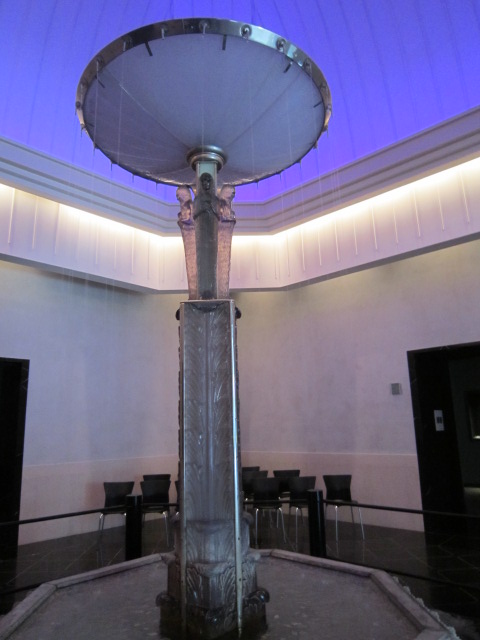
Walking back from the Hida village we almost missed what was a great experience, a small sign indicating the Hida Museum of Art, focussing on Art Nouveau and Art Décor. This hardly appears in the tourist guides but is a Japanese highlight (for us anyway). The exhibitions of varying Art Nouveau styles are held within a breath-taking modern building, black metal arranged around and through window spaces (who is the architect?). A walkway connects various displays, with marvellous views to the mountains. While there are extensive collections (made by a typically anonymous Japanese collector of immense wealth), the masterpiece around which the museum is designed is Rene Lalique’s fountain. It dates from October 1926, when the Champs-Elysees arcade was opened to great acclaim. A pair of Lalique fountains were set on a corridor style patio called “Gallery Lido”. The idea was for an ultra-modern 6 floor shopping precinct to rival the Place Vendome and L’Opera. The fountains were made of amethyst colour glass and metal with 4 panels, each of which has a motif of Acanthus leaves, above which were women figure who wore their hair long reaching to their feet and holding shells in their hands (the “source de la fountaine”).Lalique was a master jewellery designer during the Art Nouveau period. He applied lost-wax casting on glass works, which was a manufacturing process of jewellery, producing exquisite perfume bottles for Francois Coty. This led to the mass production of glass works (one room has a large collection of such bottles – great stuff). Unfortunately the Gallery Lido was pulled down just before the Great Depression. One of the pair of fountains was miraculously discovered in almost perfect condition in a suburban shed in Paris in 1989. It was restored by Lalique fans and was part of a travelling exhibition, which came to Tokyo in 1992, creating a sensation. Somehow it was purchased and is now living quietly in Takayama, protected from earthquakes by advanced technology. Glass, light and water are united. In a masterful way the light is brought to the domed ceiling, with constantly changing colours to complement the fountain coloration. Do see it if you can. More soon.