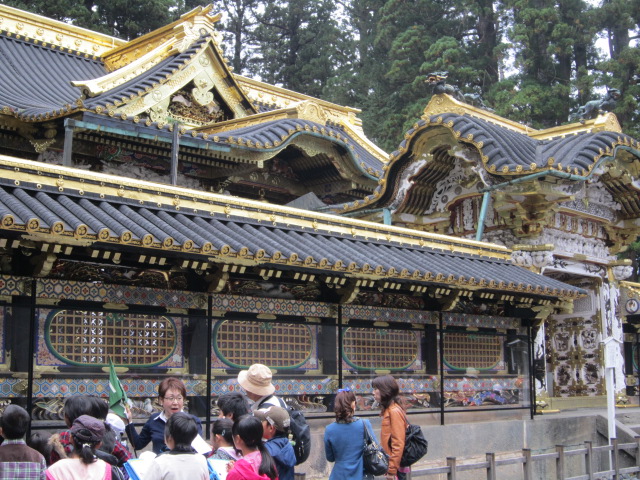
Tosho-gu Temple Nikko
Image
Reply

Our second last day, 18 October, was spent at the National Museum, full of resplendent “National Treasures”, important cultural property, illustrating Japanese history from at least the 6th century AD. An example is the Kokuzo Bosatsu of Akasagarbha, a 12th century Heian Buddhist painting of exquisite delicacy, and abundant use of silver and gold leaf. Rooms of earthenware vessels and bronze ritual items, terracotta and bronze mirrors were followed by a fascinating review of Buddhist history and art, with scrolls from Esoteric Buddhism and the court of the 9th century. Long traditional scrolls (viewed from right to left) show how important were temporal and spatial divisions, such as clouds, rocks and trees. Displays were devoted to the beginnings of Zen Buddhism in the 14th century (the first shogun government), and ink paintings of the later Muromachi period. A whole chamber is devoted to the history of the famous tea ceremony; another to military attires. Key were the samurai (“one who serves”), who dominated during the Kamakura and Muromachi eras (ironically also periods of great art). Kyoto was destroyed when the shogunate fell into decline in the Odin War (1467-77). After a century of turmoil, finally in 1600 Ieyasu reunified Japan and set up the Tokugawa shogunate in Edo (later Tokyo). The warrior class was strictly controlled. Their sword scabbards – previously gorgeously decorated – were decreed to be black and ostentation prohibited: a telling sign to experts dating items in the Edo years. Other chambers covered the gamut from screens and sliding doors, metalwork, lacquer ware, calligraphy, Noh and kabuki theatre, where actors wore elaborate masks and made highly stylized movements or did elaborate dances with music and complex plots, on to fashion, kimono robes, kanazashi hairpins, ukiyo-e (paintings of famous places, courtesans and actors) and ink paintings of every sort. We found the calligraphy particularly evocative.
On our last day we chose to visit the Koishikawa Korakuen, next to Dome City, and unlike the Imperial Palace, almost deserted. It is one of only two surviving Edo gardens in Tokyo. It was started in 1629 and showed the power of the Tokugawa clan. Again there were Chinese features, the design influenced by the famous West Lake Garden of Hangzhou in eastern China. Scenically the garden in thrilling, with characteristic lake, half moon, bridge and plantings. There are special symbolic attributes, especially the central path that wends its way through all parts. It represents the original road from the old capital Kyoto to the new capital Edo. All roads led – not to Rome – but to the mighty presence of the Tokugawas! We regretfully left this peaceful, soul-touching place, back through bustling modern Tokyo, to the airport and thus home.
So farewell to the land of ancient Japan, the land of temples and gardens, of wonderful service and politeness, impressive efficiency, the world’s best railway system and great food. It always baffles us that more westerners, and especially Australians, don’t travel to it. Japan is one of our favourite places.
We next visited the Rinnoji Temple and its beautiful garden, a haven of rest after the very popular Tosho-gu temple. After lunch (the usual organised tour lunch – we try to avoid tours if possible), we went to the Nikko Tamozawa Imperial Villa. A railway service began to Nikko in 1890, and Nikko became fashionable. The imperial court set up its summer residence there. It meshed together existing residences, a villa owned by a business man plus a villa of the Kishu Tokugawa clan, making up over 100 rooms, surrounded by exquisite gardens. The south side was reserved for the Emperor and Empress, the north for the liege and court ladies (83 rooms, so a large entourage). This retreat continued to be very popular with the royal family (much like the British royals love Sandringham) and was used until 1947. The family stayed here to escape the bombing of Tokyo late in the second world war. No longer furnished, it still gives a poignant insight into the way of life of the imperial family. The beautiful light wooden house had many vistas over the delightful garden towards the forests and mountains surrounding Nikko. [next: back to Tokyo for the last few days of our 2013 trip].
On 17 October 2013 we took a day trip to Nikko (north west of Tokyo), sacred to both Shinto and Buddhist worship. The first temple Rinno-ji was founded by Shodo Shonin in 766, the temple of Chuzen-ji in 784, and later the Fatarasan Shrine. When the first shogun of the Tokugawa clan died, the temple of Nikko Tosho-gu was built as his burial place, completed 1617. The two storey Yomei-mon (or Sunset) Gate, decorated with brilliant colours and over 500 sculptures, is particularly famous. From this gate an avenue leads to Nikko Toshu-mon Gate. The courtyard contains famous treasures by master carvers, especially Hidari Jingoro. Best known are the Three Monkeys – “see no evil, hear no evil, speak no evil” – inspired by Buddhist teaching that by so doing we shall be spared from evil. The overwhelming richness of decoration in the temple, with many Chinese references, says that the emperor respected, and was aligned with, his powerful neighbour the Chinese Empire, but also saying that the Tokugawas were here to stay and rule: which they did, until the mid-1880s.
We arrived back in Tokyo from Nagano on 14 October. Next day we spent much time at the wonderful, if not well known, Idemitsu Museum, a must in our opinion for any visitors. It was founded in 1966 by Sazo Idemitsu, a wealthy industrialist and collector. His aim was to expand Japan’s collection of art masterpieces for the benefit of future generations. The main feature on this day was an exhibition of calligraphy and ink paintings by the Zen Buddhist monk Sengai (1750-1837), who was at the Shofuku-ji temple in Fukuoka and a devotee of Rinzai Zen Buddhism. He used his talent to unravel Zen doctrines, often using simple ink brushstrokes plus calligraphy (which we un fortunately couldn’t understand). Some pictures showed great flair and sense of humour (such as his “ailments of old age”). In the final room of the museum is a shard collection put together by archaeologists specialising in pottery, taken from many kilns in Japan (and a range of other places in the world). One large room has lovely views over the Imperial Palace and its gardens (which we had visited on an earlier trip).
That evening a typhoon hit the area, suspending the metro lines, causing 17 deaths and 54 missing, and cutting off the airport for a while. We were largely oblivious to it in our hotel, and next day dawned clear. [to be continued].
“The word as normally used brings to mind pictures of distance: the transcendent is what is unattainably far off, outside our range of understanding. [Lewis helps us see] not an incalculable separation but an inexhaustible strangeness, a refusal to be captured. And in Lewis’s narrative (the Narnia stories], this is expressed in terms of rebellion, the joyful overturning of a self-contained order in the name of an uncontainable truth”: Rowan Williams, The Lion’s World, p.139.
Rowan Williams has this to say:
“It is not true that large numbers of people reject Christian faith – if by ‘reject’ we mean that they deliberately consider and then decide against it. They are imperceptibly shunted towards a position where the ‘default setting’ is a conviction that traditional Christianity had nothing much to be said for it. People who have settled down in this position are not likely to be much moved by argument: they need to be surprised into a realization that they have never actually reckoned with what Christianity is about” [The Lion’s World: A Journey into the Heart of Narnia, 2012, pp.14-15].
 Paul Crook