The Indian scholar of long ago Shankara says this:
“People grow old and die because they see others grow old and die”.
Make what you will of this!
Ageing
1

The Indian scholar of long ago Shankara says this:
“People grow old and die because they see others grow old and die”.
Make what you will of this!
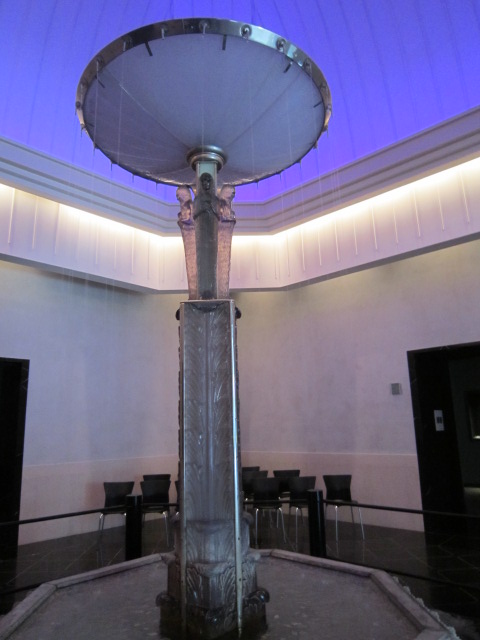 Walking back from the Hida village we almost missed what was a great experience, a small sign indicating the Hida Museum of Art, focussing on Art Nouveau and Art Décor. This hardly appears in the tourist guides but is a Japanese highlight (for us anyway). The exhibitions of varying Art Nouveau styles are held within a breath-taking modern building, black metal arranged around and through window spaces (who is the architect?). A walkway connects various displays, with marvellous views to the mountains. While there are extensive collections (made by a typically anonymous Japanese collector of immense wealth), the masterpiece around which the museum is designed is Rene Lalique’s fountain. It dates from October 1926, when the Champs-Elysees arcade was opened to great acclaim. A pair of Lalique fountains were set on a corridor style patio called “Gallery Lido”. The idea was for an ultra-modern 6 floor shopping precinct to rival the Place Vendome and L’Opera. The fountains were made of amethyst colour glass and metal with 4 panels, each of which has a motif of Acanthus leaves, above which were women figure who wore their hair long reaching to their feet and holding shells in their hands (the “source de la fountaine”).Lalique was a master jewellery designer during the Art Nouveau period. He applied lost-wax casting on glass works, which was a manufacturing process of jewellery, producing exquisite perfume bottles for Francois Coty. This led to the mass production of glass works (one room has a large collection of such bottles – great stuff). Unfortunately the Gallery Lido was pulled down just before the Great Depression. One of the pair of fountains was miraculously discovered in almost perfect condition in a suburban shed in Paris in 1989. It was restored by Lalique fans and was part of a travelling exhibition, which came to Tokyo in 1992, creating a sensation. Somehow it was purchased and is now living quietly in Takayama, protected from earthquakes by advanced technology. Glass, light and water are united. In a masterful way the light is brought to the domed ceiling, with constantly changing colours to complement the fountain coloration. Do see it if you can. More soon.
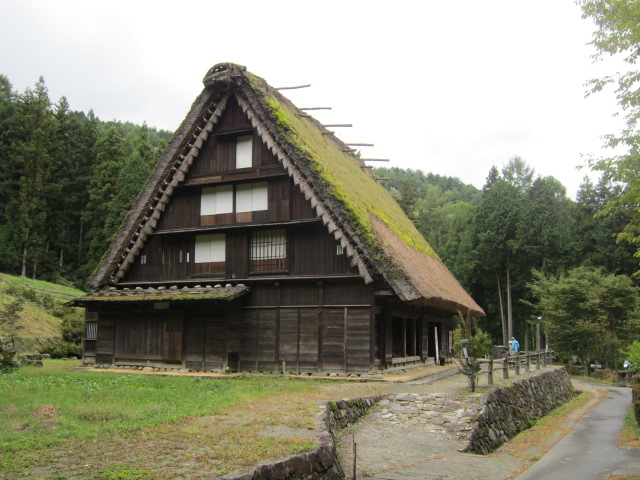
11 October: We visited the Hida Folk Village, which has gathered together in a realistic setting a large number of village buildings that had been relocated after being flooded out or threatened in their original sites. Normally this is frowned upon by archaeologists, but in this case it has been done very sensitively and the result is a most interesting site that illuminates much rural village life. The Folk Village is on the slopes of a mountain just to the south of Takayama. Next we’ll move on to the wonderful art nouveaux Hida Museum of Art nearby.
11 October
We visited the Kusakabe Mingei-kan, the house of a wealthy merchant family (re-built 1879), with its two stories of Japanese cypress, private living quarters, heavy roof beams and wooden roof tiles, kitchen, laundry and servants quarters, tatami floors,sliding screen doors and courtyard gardens. Beautifully preserved, the Kusakabe house offers exceptional insight into the way people were living and working in this lovely civilian town. Next, the Hida Folk Village.
Continuing our 2013 Japan trip, we went on 9 October by train from Kanazawa to Takayama in the mountains. We stayed in one of our favourite hotels, the Associa. We had a large room in faux Parisian style and with great views of the beautiful mountain before us. Takayama had been a fortified army town but at the beginning of the Edo period, in a campaign to weaken the power of the feudal lords (Daimyo), it was ruled directly by the Shogun (Tenryo system), the castle was demolished, the samurai left and Takayama henceforth became a town of civilians and administrative centre. The town Jinya, or prefectural government office, has luckily been conserved and is the only remaining example of such a building left in Japan. It is a fascinating complex, with public sections for the work of government, private living quarters for high officials and their families, kitchens, laundries and work areas, plus large rice storerooms (taxes were paid here in rice). The building is wood, with shingle roof, tatami floors, wooden and rice sliding screens, and garden courtyards, also a prison and punishment area (not quite the “torture room” of the Lonely Planet!). We then went on to explore the lovely old streets in the Jinya’s proximity [to be continued].
“Merton contrasts the illusory freedom of the artist ‘in revolt’ against society, DEFINED by his revolt and limited by it, who ‘cultivates antiart as a protest against the art cult of the society in which he lives’, with the true freedom which the artist should enjoy, ‘freedom from the INTERNALIZED emotional pressures by which society holds hum down’….
the dilemma of the artist is identical with the dilemma of the monk: each, at one level, rejects society, but has to guard against being defined by this rejection… the monk or artist must beware of locating all the demons of the age outside himself: the artist, like the monk, has an interior wilderness to discover”
[Rowan Williams, A Silent Action: Engagements with Thomas Merton, 2011,p.37].
Thinkers such as Thomas Merton have been preoccupied with the question why did monks (or other religious seekers after the truth) go into solitude in the desert (or into a sort of solitude in monasteries). More exactly, Merton asks what should be the real purpose of doing this? Is it to escape the sinful ethos and temptations of the city or society of normal life? Or, more meaningfully, to escape from one’s one problematic self, or ego, into nothingness, as a preparation for engagement with God? As Merton says, even though the monk is living in a community, he is bound to explore “the inner waste of his own being as a solitary”. Merton quotes from the sixth century Syrian ascetic Philoxenos, who comments on the monk who follows Christ into the desert to fight the power of error: “And where is the power of error? We find it was after all not in the city, but in OURSELVES”.
R. H.Tawney was an expert on Tudor-Stuart history and he saw parallels with the crises of the age of totalitarianism, the twentieth century (Fascism and Soviet Communism especially). He said:
“The alternative to religion is rarely irreligion; it is a counter-religion…. The apostasies waiting to succeed are legion; but the most popular claimants to the political throne have commonly been two. They are the worship of riches, and the worship of power”.
Western capitalism epitomised the first, totalitarianism the second. Democracy was under threat from both.
[The Western Political Tradition]
Tawney was a prominent figure in English socialism in the early twentieth century. His Christian Socialism, and critique of capitalism, rested on a view of each person’s equality in the eyes of God. What humans shared in common was vastly more important than differences between them (such as genetic, intellectual or artistic differences or abilities).
In Tawney’s words, it is “the truth that it is absurd and degrading for humans to make much of their intellectual and moral superiority to each other, and still more of their superiority in the arts which bring wealth and power, because, judged by their place in any universal scheme, they are all infinitely great or infinitely small”.
 Paul Crook