Kyoto

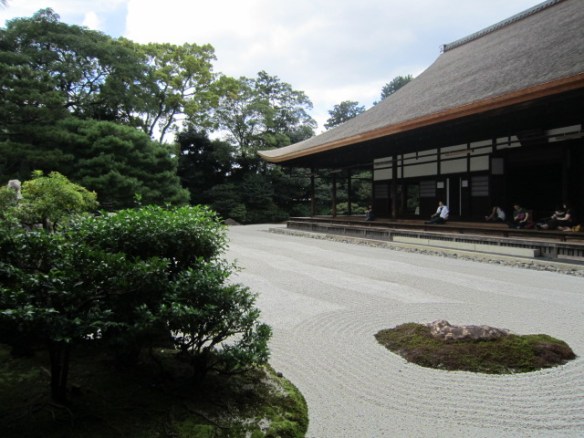
Having visited the main attractions of Kyoto on a previous visit, this time we explored further. The Traditional Crafts Museum has a fabulous display, ranging from dying fabric, weaving, making roof tiles, inlaid metal work, lacquer wear, pottery, etc. Chawanzaka Street literally means “Pottery Street” and is full of studios, where you can see exquisite plates and bowls while drinking green tea. Then on to Kennin-ji, the oldest Zen temple in Kyoto (see photo), founded in 1202 by the priest Yousai. He studied in monastic centres including China, where the Zen sect dated back to the 6th century. By strict training the Zen devotees can transcend the suffering of life to reach equanimity, wisdom and compassion. The famous tea ceremony came from China, as much else in Japanese culture. The temple’s dry landscape garden is a classic. We also spent time at the Hatto Hall, with an extraordinary dragon painting on the ceiling; and then wandered yet again through the Gion, the old part of Kyoto full of restaurants and shops. Hikone next.

Nara

Nara was the oldest capital of Japan (710-784) when the various clans of Honshu first agreed on having a central head of state. The old town has a main street, a mall, called Sanjodori, with shops ranging from kimonos, lacquer and pottery to touristy things. We visited the Sarusawa Ike Pond, full of well-fed turtles, then the precinct of the Five Story Pagoda and Kofukuji Temple. Then we went through the huge tori gate to the Nara National Museum, in an enormous park, home to large numbers of sacred deer, which roam around looking doefully at tourists who feed them “deer biscuits” sold there. The museum has a wonderful collection of Buddhist sculptures, all varying about symbolism, meaning and artistic styles. Next day we passed through an enormous gate built of colossal cedars in the 13th century, quite breathtaking. Then the mani attraction of Nara, the vast Daibutsu-den Hall of Todaiji Temple, the latest version from the 18th century, only two thirds the size of the original but still the largest wooden building in the world. In the temple hall is an enormous Buddha, flanked by another. We visited other temples and walked through beautiful scenery in a park-forest area, with a Shinto shrine by a pathway lined by tall stone lanterns. This is a favourite spot for weddings and baptisms, usually with all the works, kimonos and costumes for the kids. We spent time in the local shops looking at lacquer ware in particular and celadon ware using beautiful glazes. That night we enjoyed a traditional meal of Kaiseki dishes, special to Nara, numerous dishes served in small amounts, elegantly presented on exquisite bowls or plates, an art form, served by geisha girls. Great!
On to our favourite place Kyoto.

Okayama

14

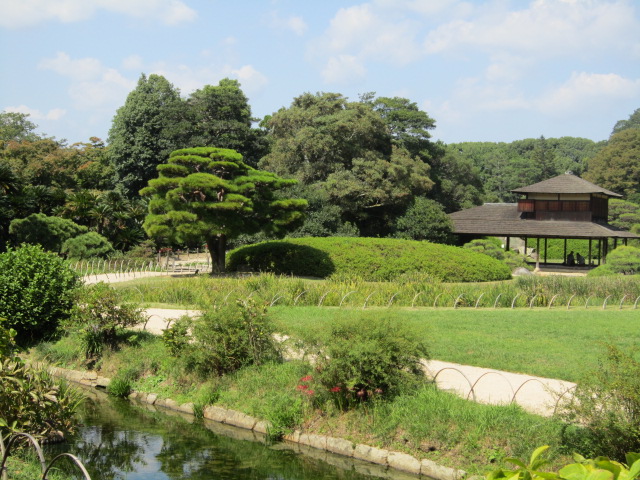
Next to Okayama by rail (all our travelling in Japan was by rail), where we quickly headed to the Korakuen Gardens, considered one of the three most beautiful gardens in Japan. It was begun by a feudal lord in 1686 and completed in 1700, and of course has been much changed over the centuries. It was  the personal place of the ruler during the period of the daimyos. After being bombed during WW2 it was restored using Edo period paintings and designs. It is in the scenic promenade style, whereby the visitor sees a new view at every turn of the path, and has man-made features such as streams, waterfalls, rocks, hills and forests, and pavilions (such as the Ryuten). Each feature has a symbolic meaning (the secret of Japanese gardens, large or miniature). Zen, for example, likes to use the sacred symbols of the circle, square and triangle. There are also lawns and little rice paddies (to remind the daimyos of the ordinary people they ruled). The colours change with the seasons, cherry blossom in April, azaleas in May and June, iris and lotus in June and July autumn colours in October (in theory anyway, autumn being late this year we missed the browns, reds and yellows almost completely).

Next day we visited Imbe to see some famous Bizen pottery ware (using techniques dating back to the 700s). It is earthy, rustic pottery and we were invited to see a kiln in action (with Japanese tea added in – the Japanese are very polite and welcoming). The potter was a master potter called Shuzoh Ogawa. On our last day we visited the Prefectural Museum of Art in a splendid modern building (there are many such in Japan, using Japanese architects, among the world’s best), and often commissioned by very rich Japanese as their contribution to culture (better than buying football teams!). Then to the Yumeji Art Museum featuring the work of Yumeji Takehisa (1884-1934), sometimes called the Japanese Toulouse-Lautrec, a founder of the Japanese Art Nouveau movement. (We were to find a good deal of Art Nouveau works in Japan, something we have a great interest in). We found his work interesting but too often there is a sentimental element, not to our taste (but perhaps like English Victorian art in some ways) – women waiting for their lovers or sadly thinking of departed ones, etc.  There was also some prefiguration of comic characters, anticipating the modern Japanese love of (or obsession with?) cartoon and comic genres. More on Nara next.

Osaka and Hiroshima

6

We had only a day at Osaka. Osaka Castle is the main attraction, begun in 1583 by the famous unifier of Japan Toyotomi Hideyoshi, destroyed a number of times across the centuries (eg 1615, 1868), reconstructed in concrete in 1931 and then refurbished at great cost in 1997. There are 8 stories, which include some museums plus a splendid view of the city from the top floor (much arduous climbing). We felt we could have stayed longer in Osaka.

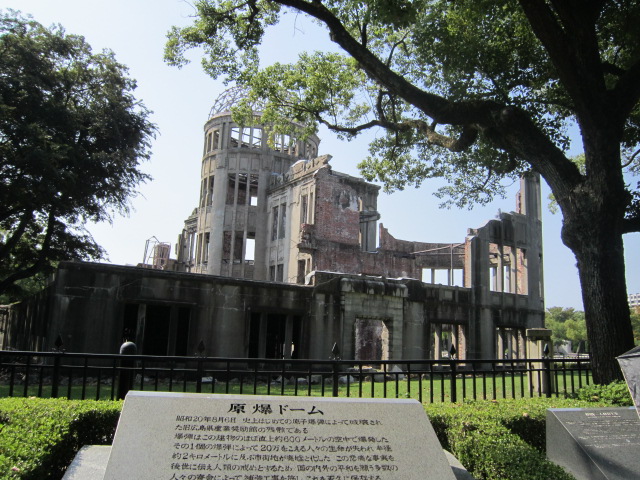
Rail to Hiroshima on our trusty Japan Rail pass (the trains are fantastic in Japan, fast, extra clean and reasonable in cost). Hiroshima was at times a gut-wrenching experience but ultimately uplifting. After viewing Fudo-in, a temple in the lower hills on the north side, in a rare surviving style of Kaga architecture, we went to the Atomic Bomb Dome and Peace Park. The Dome of cement and stone was the Industrial Promotion Hall and a centre of operations for Japan’s Fifth Army (hence a target). It became the hypercentre of the world’s first atomic blast, everyone instantly killed, building decimated but its shell remained standing. It is now propped up and conserved, with twisted metal stairs, misshapen walls and window frames, a testament to man’s savagery to man. Many wanted it taken away but it was kept and is now a World Heritage Site.

The Peace Park is ironically a very peaceful and pretty area. Hard to realise that in this area over 350,000 people died. There are features and fountains, and children play there. The Children’s Peace Memorial was inspired by Sadako, a little girl who died of leukaemia brought on by radiation. When she found out she decided to fold 1000 paper cranes. She died when she got to 644 but the children from her school folded the remaining number to fulfil her wish. The Museum is quite striking, telling a quite balanced story of Japan’s militarisation before and during WW2, the aftermath of the bomb and later history of Hiroshima, which is now a thriving city. Quite heart wrenching was the area where remnants of people’s clothes, shoes and so on are collected, together with photos of the damage. There are many personal stories about how people survived and tried to come through the great crisis. We felt that all world politicians and statesmen should have to visit the Peace Park. Next Okayama and Nara.

Memo to Antiquity

Response to Robin Derricourt’s Review of my book Grafton Elliot Smith, Egyptology and the Diffusion of Culture in Antiquity 86 (2012):569-570

I thank Robin Derricourt for his flattering reference to me in his review of my book. However I would contend against some of his judgments on Elliot Smith. He claims that, with respect to his diffusionist approach and Egypt, Elliot Smith essentially announced a grand world view, and then selected data that fitted this view. After reading in detail his writings and correspondence, it became clear to me that Elliot Smith was in fact genuinely trying to apply the same scientific principles that he had been using in his medical and evolutionary research to the issue of cultural diffusion. This was certainly the view of the eminent zoologist Solly Zuckerman, who knew him well. As I say in my book: “The grotesque caricatures and stereotypes need to end. Elliot Smith was a serious scientist in all the fields he tackled. It is grossly unfair to excise his ethnological work as some sort of aberration. In this field he devoted enormous energy to collecting as much reliable data as was then available. And he applied his formidable intelligence to it. He put forward innovative hypotheses based on such observed evidence. As a scientist he was fully aware that such hypotheses would survive only until they were disproven… If he sometimes speculated beyond his data, he did so with the purpose of stimulating debate and more intensive research” (p.126). There was in fact, as documented in my book, considerable respect (not “nearly universal criticism”) for Elliot Smith’s diffusionist theory in his early years, even from Malinowski. Also shown is the way academic opposition mounted with time, partly of course for legitimate epistemic reasons, but also because of professional rivalries and territoriality, and nationalistic factors (especially from America). As new paradigms such as Functionalism became triumphant (helped enormously by Malinowski beating Elliot Smith in the fight for Rockefeller funding), many of the fertile issues raised by Elliot Smith and co-diffusionists such as W. H. R. Rivers and W. J. Perry were basically side-stepped and never seriously scrutinised. As I tried to indicate in my Afterword, some of these themes are now being seriously researched once more, although naturally from modern stances and not – as the reviewer rightly comments – from Elliot Smith’s total diffusionist paradigm (and often in ignorance of his work, as that was effectively excluded from curricula after World War 2).

As an historian, I would suggest that it might be salutary for archaeologists and anthropologists to read more about the history of their discipline and past debates, not least because the past illuminates themes such as cultural intrusion into epistemic issues, as well as the perils of exclusive inwardness.

Emeritus Professor of History
University of Queensland, Australia

Christmas in the UK

snowy-mountainsAnn and I spent Christmas 2012 in the UK. We wanted to revive memories of former stays in Britain, but I had the nostalgic idea of revisiting London, and perhaps having a White Christmas. Snow, as it happened, did not eventuate. I had studied for my PhD in London at LSE under the supervision of Bernard Crick. Bernard went on to become a very distinguished academic and public figure. His biography of George Orwell was much acclaimed. We became life-long friends, and he visited us in Brisbane only a year or so before his death in 2008. Ann and I dropped in on LSE during our week in London. I hadn’t been to the great city for a decade or so and had never managed to visit LSE in my various trips there. So I found it staggeringly changed, modernised (wonderful new library) and expanded. I detected a notably more sociable and friendly atmosphere there now than in my days as a clueless colonial postgraduate student. The philosophy then was rather “work it out for yourselves”, whereas now there are all sorts of student support. I remember on arrival being sent in to Michael Oakeshott, a political philosopher of note and then head of LSE, a conservative in what had been a very leftish school (memories of Harold Laski and lots of Fabians). He immediately passed me on to Bernard, as he was the only one, I was told, doing anything remotely historical. I vacillated for months in choosing a topic, until frankly told to choose and get on with it, good advice. Bernard was very helpful in my getting my thesis published by Clarendon Press, Oxford.

There were many highlights in our week. They included a walk in rare sunshine across Tower Bridge, then finding St Hallows church, the oldest church in London, a beautiful if strangely hybrid church with its Georgian heart surrounded by remnants of previous ages. We revisited the British Museum. I had not been there since the renovations. They include a glass roof in its internal courtyard. In our usual nerdy way, we much enjoyed Room 50, with its excellent interpretation of early Roman and Anglo-Saxon hoards. Also, another day, the pre-Raphaelite exhibition at the Tate Britain, then a walk along the Embankment past the Houses of Parliament to Westminster Abbey and Parliament Square, with its statues of Lloyd George, Smuts, Churchill and other Prime Ministers; then to Mary Le Strand and the Cortauld Gallery at Somerset House (I have mixed feelings about its ice rink). The Victoria and Albert’s Hollywood Costume exhibition surprised us by its creativity and coverage.

Our main goal was to spend Christmas at Clare Hall, Cambridge, a college of which I am a Life Member. We travelled to Cambridge by rail, and stayed in a college guest flat at West Court, rather Spartan in the traditional college fashion, where it is thought visitors have nothing to do but study abstemiously. As we had no car, we spent a week of probably healthy long walks into Cambridge, via Burrell’s Walk and over the Cam (about 5 km); doing the usual sights – familiar to me from a number of study leaves – from Great St Mary’s, Michaelmas Hall, Lyon Yard, to the Fitzwilliam. We had vague hopes of listening to the King’s College choir on Christmas Day, but found it virtually booked up (if you didn’t want to queue from 9 till noon in inclement weather). So we settled for Candlelight Carol evensong at St Mary’s, which was quite wonderful.  We had Christmas lunch at Brown’s in Trumpington St, three courses of traditional fare with champagne cocktails and an Italian pinot noir. We spent our last day at King’s Lynn, a fascinating old seaport on the Wash, once main port for the old woollen trade with the Hanseatic League.

We drove to High Wycombe, so that we could spend a couple of days exploring the area where my family, the Crooks, had lived for centuries, before my branch of the family moved to Wales in the late nineteenth century, before emigrating to Australia in the 1920s, to escape the post-war slump in the Welsh mining industry. Some of Ann’s ancestors also came from the High Wycombe area. Among the places we visited were the charming little village of Wooburn (where Crook agricultural labourers used to live); Monk’s Risborough, a beautiful village with a lovely church, St Dunstan’s (where we discovered a grave of my ancestor John Crook); Aston Clinton, Weston Turville (where Ann’s relatives the Weedons came from); the Chilterns. Then we went on to the Cotswolds via Fairford, with its full collection of beautifully preserved medieval stained glass windows (only saved through the efforts of an influential supporter of Cromwell).We saw in the New Year of 2013 with an old friend at Chipping Campden. Being very gentry Tory country, we witnessed a local Hunt Procession. Chipping Norton nearby is the hunt centre and also the home of David Cameron (the Prime Minister). Our enjoyable trip ended with a nostalgic tour of Windsor Castle, impressively restored since the fire.

We are planning a trip to Japan around September this year (2013).