Kanazawa 6-9 October 2013

Suzuki Museum (Buddhist Studies)
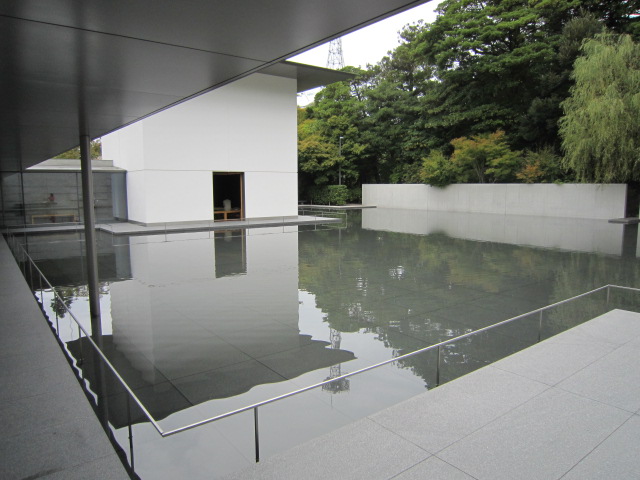
Suzuki Museum

Kanazawa is a modern thriving port with tree-lined wide streets and large stores. The Nagamuchi district near our hotel has preserved some samurai houses, with mud and straw yellow stucco walls topped with tiles. Luckily Kanazawa was not bombed during the war, and sustains many local handicrafts and traditional culture.  Kenrokuen is ranked as one of the three best gardens in Japan (which is saying something). It is a strolling landscape garden typical of the Edo period, with little villas, winding streams, stone bridges, incorporating the six attributes of a perfect landscape garden: spaciousness, seclusion, artifice, antiquity, watercourses and panoramas. Castle Park is a green moss carpeted, beautiful place, like stepping into another world. Hisagoike Pond, with its superb Midoritaki waterfall and Kaisekito Pagoda,on an islet reached by a stone bridge, is near Yugaotei,  a building from 1774 that was raised to perform the tea ceremony. If you visit Kanazawa you must visit the splendid D.T.Suzuki Museum, a contemplative oasis devoted to the memory of a great 20th century Buddhist scholar (see photo above). We loved Kanazawa, not least because its open spaces and precincts contrast so much with towns like Kyoto. Next destination Takayama.
Reason versus Imagination

C. S. Lewis wrote:

“The humblest of us, in a state of Grace, can have some “knowledge-by-acquaintance”…, some tasting of Love Himself; but man even at his highest sanctity and intelligence has no direct “knowledge about”…the ultimate Being – only analogies. We cannot see light, though by light we can see things. Statements about God are extrapolations from the knowledge of other things which the divine illumination enables us to know” (The Four Loves).

He is saying that while Christianity respects reason and is consistent with it, reason and reductionist empirical views of “reality” are insufficient to appreciate transcendental truths. For this we need spiritual, emotional and imaginative abilities.

C. S. Lewis’s “Surprised by Joy” and mysticism

C. S. Lewis’s book Surprised by Joy (1955) refers to his mystical experiences. They are seen as transcendental experiences, possessing (in William James’s terms) luminosity and authority and giving access to an inner truth. During his childhood Lewis had felt an intense longing for something elusive, triggered by (say) the fragrance of a currant bush or a piece of poetry. As he said “It is difficult to find words strong enough for the sensation which came over me… It was a sensation, of course, of desire; but desire for what?… And before I knew what I desired, the desire itself was gone, the whole glimpse withdrawn, the world turned commonplace again…” Lewis’s biographer Alister McGrath sees these moments as epiphanies, sparked by Lewis’s intense commitment to literature in which he found great moments of illumination and truth (in Wordsworth, or the sagas), in which everyday human experience is engaged with and in which underlying significances are found.

(Source: Alister McGrath, The Intellectual World of C. S. Lewis, 2014, pp.109-111).

Letting go of self

I’ve been reading about a writer who had tried every meditation practice known to man and found them unsatisfactory. He finally gave up on them and “took no special attitude”. To his amazement this “letting go” freed him. As he said, in throwing away these expectation he seemed “to throw myself away as well”. He felt that ” I owned nothing, not even a self, and that nothing owned me. The whole world became as transparent as my own mind. The ‘problem of life’ simply ceased to exist, and for eighteen hours I and everything around me felt like the wind was blowing leaves across a field on an autumn day”.

(quoted in Deepak Chopra, Ageless Body, Timeless Mind, 1993, pp.297-8).

C. S. Lewis and Myth

I’ve just been reading about C. S. Lewis, who is famous of course for his Narnia stories. He was also a leading writer on religion, an “apologist” for Christianity if you like, around the second word war period.

I found particularly interesting what scholars have said about his use of myth. His interest in this was spurred on by his fellow “Inkling” J. R. Tolkien (author as you all know of the Lord of the Rings series). Lewis came to see that the great Greek and Roman myths were compatible with Christianity. He had previously thought that they were incompatible. Now he argued that the old myths of the Norse and classical Graeco-Roman worlds were anticipations of the full truth, the grand narrative or “big picture” that was offered by Christian faith. As Lewis wrote in an essay, we should expect to find “in the imagination of the great Pagan teachers and myth-makers some glimpse of that theme which we believe to be the very plot of the whole cosmic story – the theme of incarnation, death and rebirth”. 

Kyoto

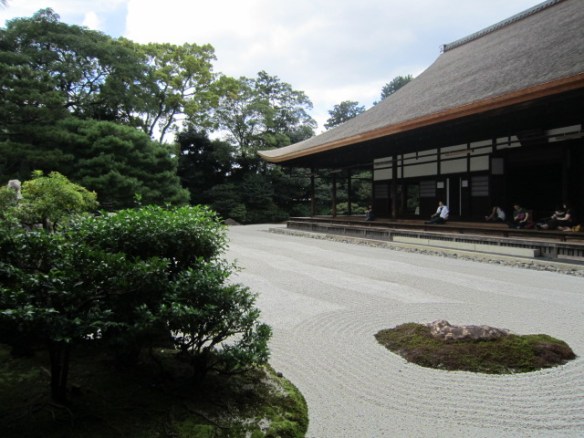
Having visited the main attractions of Kyoto on a previous visit, this time we explored further. The Traditional Crafts Museum has a fabulous display, ranging from dying fabric, weaving, making roof tiles, inlaid metal work, lacquer wear, pottery, etc. Chawanzaka Street literally means “Pottery Street” and is full of studios, where you can see exquisite plates and bowls while drinking green tea. Then on to Kennin-ji, the oldest Zen temple in Kyoto (see photo), founded in 1202 by the priest Yousai. He studied in monastic centres including China, where the Zen sect dated back to the 6th century. By strict training the Zen devotees can transcend the suffering of life to reach equanimity, wisdom and compassion. The famous tea ceremony came from China, as much else in Japanese culture. The temple’s dry landscape garden is a classic. We also spent time at the Hatto Hall, with an extraordinary dragon painting on the ceiling; and then wandered yet again through the Gion, the old part of Kyoto full of restaurants and shops. Hikone next.