What do you want from a funeral?

A recent loss in my life prompts me to quote this from Howard Jacobson:

“I know what I want from a funeral. I want desolation. Howl, howl. If it truly doesn’t matter whom we burn or bury next – for we are but a mote in Creation’s eye – then that is all the more terrible for the dead and all the more desolating for those of us still standing. The end of a life, if we believe a life has meaning, is a dreadful event. The end of a life, if we believe a life has no meaning, is a more dreadful event still. Twist it how you like, death is neither decorous nor rational nor humane….

At last, if we have been allowed to feel the enormity of a single lost life, there may follow a conviction of the grandeur of all lives. But nothing follows if we don’t first find word for the magnitude of our despair.

And for this you need the psalms and liturgies of the great religions”.

[Whatever It Is, I don’t Like It, Bloomsbury, 2011m pp.206-7].
Fellowship versus selfish individualism

I have been reading about the English historian and well known Labour thinker of the early 20th century R. H. Tawney (his most famous work was Religion and the Rise of Capitalism, 1926). I like this comment on Tawney by Adam Seligman:

“The whole idea of society as composed of individuals who came to be conceived of as the profit-maximising individuals of current exchange theory was abhorrent to Tawney’s view of society and of the individual as well. For Tawney’s view of society was primarily as a moral community, united by…a shared vocabulary of worth and value”.

As Seligman points out, Tawney found the moral authority for ethical conduct in his Christian faith, “in its call…to obey God and not worldly power where the demands of conscience and … power collided”. This was based on  Christian belief in human equality before God. People were not equally clever or virtuous, but were “of equal value”.

[Adam B. Seligman, “R. H. Tawney and Scholarship”, Society, 35, 1998, p.64].

Death and the Cosmos

Over the years I have often imagined death in relation to the cosmos. There is a sort of science fiction feel, perhaps a TV documentary on space, the stars, galaxies (Brian Cox sort of thing).

I envisage an imaginary observer travelling through the great rush of stars, planets that is part of the dynamic expanding universe after the Big Bang, coming towards us here on earth, then heading off away from us towards the outer edges of space and into infinity (or whatever is beyond the knowable universe, or knowable so far – we keep learning more and more about it all the time).

I have a vision of our spirits, as we age then die, travelling out with that outgoing rush of stars, until we finally become mere dots on outer space, then fade completely away. It’s a vivid feeling, and perhaps not so strange when we think that our atoms, the atoms of everything, are indestructible ultimately, and are just rearranged in the endless mutations and transformations of the universe. Have any of you had similar feelings?

New Post on Middleton Murry

See new post under Writings for an extended analysis of John Middleton Murry’s views on British society and the church in the twentieth century. One quote from Murry:

When democracy “spews the coal out of its mouth” it becomes not only barbaric but “something new…a Christian society which has reverted, and bears the mark of its apostasy upon it”.

Marxism and Christianity

Middleton Murry had no time for those fellow Christians who just dismissed Marxist theory out of hand. He himself could be described as a Christian Socialist. This didn’t mean he believed in Marxist ideas such as the dictatorship of the proletariat, revolution or atheism. But he saw a great truth in Marx’s idea of humans being governed by forces of economics and class struggle. You couldn’t answer such strong analysis by simply asserting the Christian doctrine of free will, that individuals were free to do good or evil. This was “pious nonsense”. The ordinary worker was “the passive and unconscious slave of an economic system which he does not understand, and which he makes no effort to control”. What was the Christian answer? Murry advocated a full commitment of the churches to thorough-going social and economic reform, a commitment to effective regulation of capitalism. A revived Christianity needed to aim at a moral conversion of society, away from the excesses of economic individualism and self-interest.

[Murry, The Price of Leadership, 1938, pp.152-153].

Kanazawa 6-9 October 2013

Suzuki Museum (Buddhist Studies)

Suzuki Museum

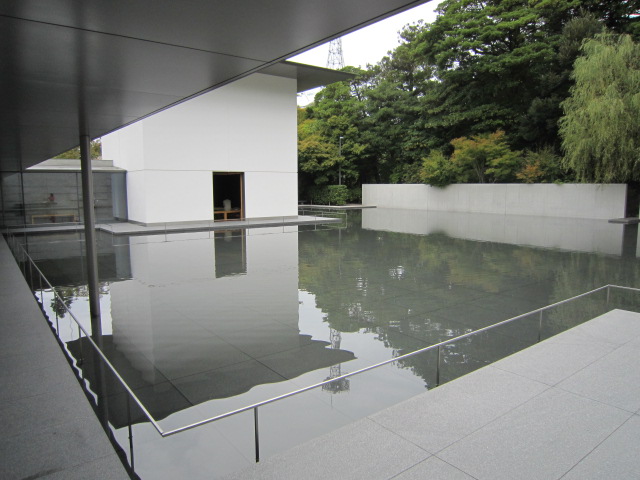
Kanazawa is a modern thriving port with tree-lined wide streets and large stores. The Nagamuchi district near our hotel has preserved some samurai houses, with mud and straw yellow stucco walls topped with tiles. Luckily Kanazawa was not bombed during the war, and sustains many local handicrafts and traditional culture.  Kenrokuen is ranked as one of the three best gardens in Japan (which is saying something). It is a strolling landscape garden typical of the Edo period, with little villas, winding streams, stone bridges, incorporating the six attributes of a perfect landscape garden: spaciousness, seclusion, artifice, antiquity, watercourses and panoramas. Castle Park is a green moss carpeted, beautiful place, like stepping into another world. Hisagoike Pond, with its superb Midoritaki waterfall and Kaisekito Pagoda,on an islet reached by a stone bridge, is near Yugaotei,  a building from 1774 that was raised to perform the tea ceremony. If you visit Kanazawa you must visit the splendid D.T.Suzuki Museum, a contemplative oasis devoted to the memory of a great 20th century Buddhist scholar (see photo above). We loved Kanazawa, not least because its open spaces and precincts contrast so much with towns like Kyoto. Next destination Takayama.

Letting go of self

I’ve been reading about a writer who had tried every meditation practice known to man and found them unsatisfactory. He finally gave up on them and “took no special attitude”. To his amazement this “letting go” freed him. As he said, in throwing away these expectation he seemed “to throw myself away as well”. He felt that ” I owned nothing, not even a self, and that nothing owned me. The whole world became as transparent as my own mind. The ‘problem of life’ simply ceased to exist, and for eighteen hours I and everything around me felt like the wind was blowing leaves across a field on an autumn day”.

(quoted in Deepak Chopra, Ageless Body, Timeless Mind, 1993, pp.297-8).